RSS
 

Welcome Pete Licata!

03 Jan

We are proud to announce the newest member of our team. 2011 USBC Champion and World Barista Championship 2nd place winner Pete Licata. We had worked closely with Pete in 2011 in his Journey to the WBC. His extensive knowledge of espresso and cafe operations are a valuable addition to our company. We look forward to creating many new espresso blends with him in the near future.


USDA 762

18 May

I first heard of USDA 762 from the newly formed Specialty Coffee Association of Indonesia in 2007 or 2008. On their website they listed coffee varieties being grown in Indonesia and had a section discussing Ethiopian lines

mentioned are 3 varieties: Abyssinia, Rambung and USDA. The former two I have done some of research on but that is another story. The USDA one i have found most interesting as it is being grown by a number of farmers in Bali and likely other areas as well where as the former I have yet to hear of any large group of farmers who is growing in Indonesia though i suspect they do exist.

I had scoured the internet for references to this varietal on several occasions in the past couple years. The name USDA 762 was mentioned several times in reference to an Ethiopian line introduced by Americans in the 1950’s or early 1960’s. But for a long time that was all the info i could find on this variety. Early 2011 I found another piece of info that held the key to unraveling the origins of this cultivar. I can’t remember the source any more but I found out that 762 was a shortened form of a longer number – 230762. I had no idea what this # meant but searching that number and the right key words in google scholar led to a reference to it. a match was found in a paper published by the USDA July 1960 – ‘Coffee Germplasm Collection and Distribution’

I wasn’t able to read this paper online or order it but I called my friend Dr Shawn Steiman of Coffea Consulting to see if he might be able to track down this paper for me. I had mostly forgotten about it the past couple months, but then Shawn was visiting the Big Island for the Ka’u Coffee Festival over the weekend and he told me he had the paper I had asked for. (Thanks again Shawn) Most of the time looking through loads of information in these papers I don’t find what i’m looking for. But this time I was lucky. A little more information and another clue into finding the exact origins of this variety.

Plant Introduction No: 230762

Name under which seeds or plants were Rec’d: C. arabica Lejeune’s #8 Line 108

Year Received: 1955

CRRC (Coffee Rust Research Center, now CIFC in Portugal) No: 536

Type Resistance (referring to rust): E and C

Finally knowing what the number 230762 was (the USDA plant Introduction #) it only took a couple of late night searching through information to find out more about this introduction.

Plant Material Introduced January 1 to Dec 31 1955. USDA June 1964

230729 to 230780. COFFEA ARABICA L. Rubiaceae. Arabian coffee.

From Ethiopia. Seeds collected by Jean B. H. Lejeune, Food and Agriculture Organization

of the United Nations, Addis Ababa. Received Dec. 20, 1955.

Collected in the forest region of Kaffa Province, about 16 miles from Mizan Tafari.

October, 1955.

230759 to 230778. From Mizan Tafari. Elevation 4,700 feet.

230759. Line 0105. 230765. Line 0111.

230760. Line 0106. 230766. Line 0112.

230761. Population 0107. 230767. Line 0113.

230762. Line 0108. 230768. Line 0114.

From 1954 -1956 JBH Lejeune a French Reseacher was sent by the FAO to collection specimans of wild coffee. Until receiving the paper from the USDA i was unaware of this but the USDA received much of the seeds from many of these expeditions and then distributed them to the various coffee research gardens/germplasm collections around the world and to the coffee rust research center in Portugal.

I finally found the documentation showing that USDA 762 was an Ethiopian line and where it was collected from. and Where it was collected from is quite interesting. Mizan Tafari. To most that likely means nothing… unless you have spent way too much time researching the history of the Geisha cultivar. (here is good starting point on Hacienda Esmeralda’s website) The area in Ethiopia known as Geisha/Gesha gave birth to the varietal Panama is now famous for is very near Mizan Taferi. At first this sounded surprising, but also in the context of what was going on in coffee breeding at the time it makes perfect sense. In the 1950’s breeding programs were underway in Kenya and Tanzania as well as Central America utilizing Geisha for its leaf rust resistance. Geisha was known for having poor yields so it was crossed with other higher yielding varieties. By the late 1950s the USDA already had several introductions of Geisha/Caturra hybrids. That an expedition was sent to look for other wild varieties that might offer similar resistance and other desirable agronomic traits isn’t a surprise. The Kaffa province is also one of the areas of greatest genetic diversity in coffee and larger scale expeditions were launched in the 1960’s by FAO and ORSTROM that also made collections near Mizan Tafari and attempted to reach the site the original geisha plants were collected from. Rust resistence was in important part of coffee breeding at the time and wild arabica coffee is where people were looking to find it. This was before the Timor hybrid became the main plant material used for rust resistance breeding. Sure enough USDA 230762 is listed as showing the same type of rust resistance as the Geisha. Given rust is a major problem in Indonesia and much of Asia it makes sense that this variety would be introduced to Indonesia. I don’t know yet but i suspect that 230762 was not the only introduction to Indonesia, but that this selection had some other desirable agronomic traits and good field performance there and was introduced to farmers there for that reason. It must have decent yields as it is even recently being recommended for planting.

Superior varieties of Arabica Coffee

“In addition, to overcome the problem of marginal land, in 1995 has been released varieties of S 795. In addition to good productivity (1500-2000 kg per hectare coffee market), this variety also tolerant to leaf rust disease, which can be grown from 700 m asl At the same time also released varieties Abesinia 3 and USDA 762. Although the result is lower power due to less leaf rust disease resistance, but the two varieties is the choice for the grower who own land above 1,000 m above sea level, fertile land with the type of wet climate and have limited manpower. “

Like the Geisha and many other Ethiopian lines rust resistance has largely been overcome and these plants never had the kind of resistance the Robusta hybrids exhibit. So it is only recommended now for higher elevations where rust isn’t as big of a problem. this is good news. An Ethiopian cultivar being grown in the highest elevations available at a latitude and altitude similar to it’s native environment. I havent had a chance to cup yet but some other have and I have heard the cup quality is better than other cultivars being grown. I have stumbled onto a Japanese site that suggests it maybe similar (in morphology atleast) to the S4 Agaro varietal which i have cupped and can say is quite excellent and exhibits the citrus and floral qualities one generally associates with Ethiopian coffee and the Geisha. Being from very near where the Geisha was collected doesnt mean it is genetically similar to Geisha. Quite the opposite is likely as this is a center of most of the genetic diversity in arabica.

I still have some unanswered questions. What is the morphology of this plant like (If anyone who has been to Bali has some good pictures i would love to see them). Was there any reason why this plant was originally collected in Ethiopia and what traits does it have that led to it being recommended for planting. Many ethiopian lines have been experimented with around the world but few have ever been distributed to farmers. Some of the answers might be found in this report “Lejeune, J.B.H. 1958. Rapport au Gouvernement Impérial d’Ethiopie sur la production caféière. FAO, Rome, Italy.” … Another paper to try and track down.

Most people don’t think of Indonesia when they think of Ethiopian cultivars but the earliest Ethiopian coffee researched perhaps anywhere occured there. In 1928 coffee researcher PJS Cramer in Java brought back coffee plants from Ethiopia. (see ‘A Review of Liturature of Coffee research in Indonesia’ page 103 &104)

Simply called Abyssinia (as Ethiopia was then called) Cramer had been looking to other species that might be cross bred with Arabica to produce disease resistant cultivars at the time and happily discovered resistance to rust in the Arabica plant he brought back from Ethiopia. I don’t know where to find this plant in Indonesia, though it is apparently still being recommended for planting in some areas. But it does exist in other parts of the world under a different name. that from which is was distributed… Java.


Congratulations, Pete Licata!

01 May

Yes!! Pete Licata of Honolulu Coffee Co. is the new United States Barista Champion!

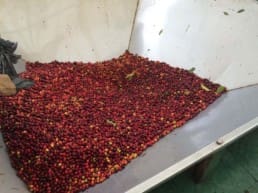
Pete picked and processed his own coffee for the competition from our partner farms: Rusty’s Hawaiian and Waiono Meadows. Pete will compete in the World Barista Championship in Bogota, Colombia in June.

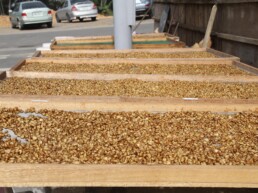
As the storytellers behind Rusty’s Hawaiian, we thought it would be fun to follow Pete like paparazzi and give you a taste of the artisan processing methods developed by Miguel Meza and Lorie Obra of Isla Coffee.

Here is our video of Pete picking and processing his coffee on his journey to the USBC:

 
Comments Off

Posted in Uncategorized


2011 Kaapi Royale Origin Tour

11 Apr

On January 3rd, 2011, Miguel Meza and Ralph Gaston of Isla Coffee traveled to Bangalore, India to tour the coffee growing regions in the state of Karnataka.

Two weeks later, they returned…and brought with them photos, videos, and several stories to tell about a truly amazing experience.

We could rhapsodize for days about the amazing views from the Baba Budan Hills that overlook Chikmaglur, or the vibrant coffee scene in Coorg. We can still taste the organic natural robusta from Sethuraman Estate, and remain awed by the size and splendor of Mysore Palace.

But rather than hear us talk about it, we’ve put together this video so you can see for yourself. Isla Coffee is proud to present ‘The 2011 Kaapi Royale Origin Tour.’
Let us know what you think.

For more information on Kaapi Royale, head over to their website, indiancoffee.wordpress.com.

 
Comments Off

Posted in Uncategorized


Congratulations Pete Licata!

08 Mar

Great Job Pete! Pete Licata won the 2011 South Western Regional Barista Competition using all Hawaiian coffees. he picked processed and roasted himself (from Farms we we work with) from Kona a washed coffee from Waiono Meadows. From Ka’u Natural and Honey coffees from Rusty’s Hawaiian. Hawaii is proud of you. now bring it home again in the USBC.


Watch live video from SCAA/USBC on Justin.tv

 
Comments Off

Posted in Uncategorized


30 Jan

Cool new Beach Bum Cafe

If your in Oahu head to Beach Bum Cafe in Honolulu and try our natural Kona maragogype on their siphon bar.

 
Comments Off

Posted in Uncategorized


roasted coffees now available in Honolulu

28 Jan

Beach Bum Cafe in Honolulu is open and serving several roasted coffees from Isla! Hawaii’s first single cup brew bar serving 100% Hawaiian coffees. check them them out for our all Hawaiian espresso blend and Ka’u Yellow Bourbon Nano-lot.

Here is there press release.

New Microbrew Coffee House Opens in Downtown Honolulu

Beach Bum Café, located at 1088 Bishop Street, Suite 101, Honolulu, HI, 96813, celebrates its grand opening during Downtown Honolulu’s First Friday on February 4th, 2011. Special business hours on this day are 7AM to 9 PM.

Beach Bum Café, a new microbrew coffee house, serves and sells only 100% Hawai’i-grown coffee. The café features coffees specially chosen for their unique and extraordinary flavor by owner Dennis McQuoid, with the assistance of Shawn Steiman of Coffea Consulting. The coffee selection includes brews and beans so rare they are served nowhere else in Hawai’i. The microbrew café model allows customers to select from a multitude of coffees and brew methods, including espresso, Chemex, vacuum pot, and cloth filter. Each beverage is made explicitly for the customer, one cup at a time.

Beach Bum Café is the brainchild of Dennis McQuoid. “I looked around and realized that no café on Oahu serves what I call ‘thought-provoking coffees,’ so I decided to open Beach Bum Café to fill the niche,” McQuoid says. “As far as I know, no café in Hawai’i has yet to attempt this type of microbrew service and variety of coffee selection. Even our espresso blend is 100% Hawaiian coffee, which is very unusual.”

Concerning an unusual name for a café in downtown Honolulu, Dennis explains, “Two things Hawai’i is most famous for: beautiful beaches and wonderful coffee. Both invoke feelings of relaxation and rejuvenation. Those are the feelings we wish to inspire when you enjoy the best Hawaiian coffee prepared to perfection at our coffee house. And who wouldn’t want to be a beach bum, even if only while daydreaming over a sweet-smelling cup of Hawaiian coffee?”

Beach Bum Café’s regular hours of business will be Monday through Friday, 7 am to 4 pm. The café will also open for special events, such as First Fridays. The menu, featuring currently available coffees, will be posted on the company website, www.beachbumcafe.com.

 
Comments Off

Posted in Uncategorized


New Site Coming Soon

24 Jan

Isla Coffee is undergoing some exciting new changes and so we will be launching our new site shortly, along with many more new offerings.

 
Comments Off

Posted in Uncategorized